Law, Justice and Journalism

Archive for the ‘Events’ Category

Upcoming event, 11 July: Public Service Broadcasting in the Era of Austerity

In Broadcasting, City University London, Events, Journalism, Media policy on July 10, 2025 at 8:16 am

In light of the Greek government’s decision to close down the public broadcaster ERT and make its employees redundant - as part of the latest public spending cuts imposed to meet the terms of the country’s bailout deal - City University London is hosting a half-day conference on PSB in the age of austerity:

  • Location: City University London (Room A130, School of Social Sciences)
  • Time: Thursday 11 July, 11-5pm
  • Booking: The event is free to attend and coffee/tea/lunch will be provided. A wine reception will follow the event. Please RSVP P.Iosifidis@city.ac.uk if you wish to attend for catering purposes.

The following themes, among others, will be addressed –

  • What has happened to ERT and how the rise of the far right in Greece, the rise of social tension, has made it all important for Greece to have an impartial public service broadcaster;
  • Wider implications for PSB in Europe; Subsequent attacks on the BBC by right wing politicians as well as commercial operators;
  • Political and market/commercial pressures for a smaller PSB service in the era of austerity;
  • The role of PSB in supporting democracy and freedom of speech;
  • PSB, production of quality programmes, impact on children and young people

Confirmed speakers/discussants include:

  • Professor Steven Barnett (U of Westminster)
  • Professor Patrick Barwise (London Business School)
  • Professor Jean Chalaby (City University London)
  • Professor Sylvia Harvey (U of Leeds)
  • Dr. Irini Katsirea (Misslesex U)
  • Professor Jeanette Steemers (U of Westminster)
  • Professor Lorna Woods (City University London)
  • Roger Mosey (Editorial Director, BBC; Executive Board of EBU)
  • Nicholas Jones (former BBC political and industrial correspondent)

TIMETABLE

10:30 – 11:00: Welcome – tea/coffee

11:00 -13:00: The closure of ERT and the implications on freedom of speech

  • Chair: David Obrien (City University London)
  • Petros Iosifidis (City University London) ‘the ERT story’
  • Irini Katsirea (Middlesex U) ‘the high court decision about ERT’
  • Nicholas Jones (former BBC political and industrial journalist) ‘PSB: A vital role at times of strife’
  • Steven Barnett (U of Westminster)
  • Discussant: Patrick Barwise (London Business School)

13:00 – 14:00: Lunch

14:00 – 16:00: The Role of PSB in society

  • Chair: Howard Tumber (City University London)
  • Lorna Woods (City University London) ‘obligations to provide PSB under EU law’
  • Jeanette Steemers (U of Westminster) ‘PSB and children’
  • Jean Chalaby (City University London)
  • Roger Mosey (Editorial Director, BBC; Executive Board of EBU)
  • Discussant: Sylvia Harvey (U of Leeds)

16:00 – 17:00: Wine Reception
Open justice in the digital era and data protection

In Events, Journalism, Justice, Research on June 5, 2025 at 10:21 am

By Judith Townend

I had the chance to discuss the Centre’s ‘Open Justice in the Digital Era’ project yesterday, at the first joint seminar of the DP Forum and NADPO (The National Association of Data Protection Officers).

The theme was ‘The challenges of complying with evolving standards’, and the other speakers included: Martin Hoskins, data protection consultant; Judith Jones, Group Manager, Government & Society, Information Commissioner’s Officer; Robert Bond, Head of Data Protection and Information Security at Speechly Bircham; and Lynne Wyeth, Head of Information Governance, Leicester City Council.

It provided a fascinating insight into the regulatory and legal challenges ahead (especially in view of the EC’s draft General Data Protection Regulation*), both in terms of the theoretical framework and practical issues on the ground for DP officers (whose number is set to increase, if EC proposals go ahead).

I introduced the Centre for Law, Justice and Journalism’s ‘Open Justice in the Digital Era’ project and the privacy-related issues we have stumbled upon, in discussing potential recommendations for more efficient and systematic digitisation of courts information. There are important issues to consider around Data Protection, Rehabilitation of Offenders and the ‘Right to be Forgotten’, a concept included in the draft Regulation.

A quick summary can be found on my Meeja Law blog.

*A vote on on the lead rapporteur’s report regarding amendments to the Proposed Regulation, scheduled for 29 May, has been postponed, as a result of the high number of amendments to consider.

Conference, 3 May 2013: Obstacles to Free Speech and the Safety of Journalists

In Events, Journalism, Law on April 16, 2025 at 9:42 am

Date/time: Friday 3 May 2013, 11.00 - 16.30

Location: City University London, City Law School, Northampton Square campus, St John Street, EC1R 0JD, London, United Kingdom

Organisers: City Law School and the Centre for Law, Justice and Journalism

The conference aims at celebrating the World Press Freedom Day by addressing some of the most topical issues affecting the protection of journalists through internationally established standards. The event stems from City’s commitment to the implementation of the UNESCO-steered UN Inter-Agency Action Plan for the Safety of Journalists 2013-2014. Issues considered will include the scope and effectiveness of extant international guarantees securing personal safety and freedom of expression for media workers in conflict and non-conflict zones, problems of compliance by States with duties arising under international human rights and humanitarian law, and potential strategies for further enforcement.

Confirmed speakers include:

  • Geoffrey Robertson QC, Doughty Street Chambers
  • Professor Bill Bowring, Birkbeck College, University of London; Field Court Chambers; European Lawyers for Democracy and Human Rights
  • Nathalie Losekoot, Senior Programme Officer (Europe), ARTICLE 19
  • Professor Jacqueline Harrison, University of Sheffield; Chair, Centre for Freedom of the Media
  • Dr. Damian Carney, Principal Lecturer, University of Portsmouth School of Law
  • Merris Amos, Senior Lecturer, Queen Mary University of London
  • Jim Boumelha, President, International Federation of Journalists
  • Dr. Carmen Draghici, Senior Lecturer, The City Law School, City University London

The conference will be of interest to academics, media NGO representatives and practitioners specialising in international law, civil liberties and human rights law, international humanitarian law, and media law.

The event is free of charge. A lunch buffet will be offered to all participants. To register please contact Dr. Carmen Draghici at Carmen.Draghici.1@city.ac.uk by 30 April 2013.

Upcoming event, 6 March 2013: The Future of Humanitarian Reporting

In Comment, Events, Journalism on March 1, 2025 at 9:59 am

Glenda Cooper

The Haitian earthquake, January 2010: a man performs brain surgery on a 15-year-old girl; a second writes a gripping eye-witness account for the Guardian about the dead bodies piled up in the street.

In the past it would have been pretty obvious which was the journalist and which the aid worker. But Dr Sanjay Gupta was working for CNN as a reporter when he carried out the surgery; Prospery Raymond, who is named as the author of the Guardian piece, was Christian Aid’s country manager who survived the quake.

Meanwhile the latest news was being broken via social media. As the Columbia Journalism Review noted, new media platforms such as Twitter, Facebook and Skype were crucial in delivering early information about damage and relief efforts. By the time Hurricane Sandy occurred two and-a-half years later, people were using the photo app Instagram to upload pictures of the storm at the rate of 10 a second - 1.3 million hashtagged in total.

We’ve come a long way since Michael Buerk’s seminal piece from Korem in 1984. As a piece of journalism that report still has the power to move and shock. But what is astonishing is that in seven minutes only two voices are ever heard: Buerk and a white Medecins Sans Frontieres doctor.

But what does it mean for the way we report humanitarian disasters in future if ordinary citizens can break the news, aid workers can act as journalists, while journalists cross the line and get involved?

What kind of pictures and reporting are we exposed to if anyone can upload pictures of a dying victim of a hurricane - or a dying dictator, as happened in the case of Gaddafi?

And while a wealth of user-generated content made the 2004 tsunami a mega-story and saw mega amounts of aid donated ($1,241 per survivor - 50 times the worst-funded crises that year, according to the Red Cross), what kind of disasters will we end up covering if it takes tweets and Facebook updates to get our attention?

Next week, a conference organised by City University’s Centre for Law Justice and Journalism, in partnership with the Red Cross, will debate these very issues with some of the foremost names in academia, journalism and aid work. It will look at the latest developments in the use of UGC by mainstream media and aid agencies, the relationship between journalists and aid workers now that social media is a factor, and consider how, in a Twitter age, we should think about reporting emotion and trauma?

Speakers include:

The BBC College of Journalism will be blogging from the conference: full programme. Places are limited. If you wish to attend please email Peter Aggar, or for any queries about the schedule contact Glenda Cooper.

This post first appeared on at the BBC College of Journalism.

Upcoming talk, 28 November, University of Southhampton - Scandal Without End: Sir Jimmy Savile, child sexual abuse and the BBC crisis

In Events, Journalism, Justice on November 22, 2025 at 9:49 am

Upcoming event: Scandal Without End: Sir Jimmy Savile, Child Sexual Abuse and the BBC Crisis

Where and when: Wednesday 28th November at 4pm,Institute of Criminal Justice Research, University of Southampton. Building 4, Law School. Room 4005 Highfield Campus. Light Refreshments will be available.

Speakers: Chris Greer and Eugene McLaughlin.

On 3 October 2025 a heavily trailed ITV documentary branded Sir Jimmy Savile as a manipulative sexual predator. The resulting scandal around ‘Savile-as-child-abuser’ destroyed Savile’s ‘cultural icon’ status and implicated multiple institutions on charges of facilitation, failure and denial. The intensification of the scandal has to date resulted in the establishment of police investigations into hundreds of sexual abuse allegations, arrests, official inquiries, vigilante activities and the resignation of the Director General of the BBC. In this paper we trace the origins and development of the ‘Savile-as-child abuser’ scandal, and apply the ‘scandal amplification spiral’ (Greer and McLaughlin, 2012) to make sense of how, why and with what consequences the affair has escalated into a full blown institutional crisis for the BBC.

  • Flyer [PDF]
  • Chris Greer is co-director of the Centre of Law, Justice and Journalism, City University London
  • Eugene McLaughlin is Professor of Criminology, University of Southampton

Professor Lorna Woods: Freedom of Expression and the Internet

In Events, Journalism, Law, Media regulation, Resources on November 19, 2025 at 9:01 am
Professor Lorna Woods, Associate Dean for Research and Professor of Law, City University Law School, gave a talk at the Institute of Advanced Legal Studies (IALs) on 14 November 2012, which discussed ‘Freedom of the Expression and the Internet’.

Her slides are available below:
Read the rest of this entry »

Cybercrime and the culture of fear

In Events, Journalism, Law on November 14, 2025 at 2:24 pm

Cybercrime, the culture of fear and internet ‘myths versus realities’ were the themes of a seminar given by Professor David Wall, Professor of Criminology, Durham University, at the Centre for Law, Justice and Journalism last week.

It was apt then, to hear Royal United Services Institute (RUSI), research fellow Jennifer Cole on the Radio 4 Today programme this morning emphasising that the Institute’s conference would not be about “cyber warfare” [08:45 am], but “strategic alliances in cyberspace”. It will look at political and economic relationships with other nations and states and whether these differ in the cyber domain from the ‘real world’, she said. She is to chair a discussion on international cyber co-operation for the 21st century at the RUSI conference, 14-15 November.

In his seminar Wall had argued that the roots of cybercrime are cultural rather than scientific, and shape the way that we view and react societally to online deviance. It is, he says, important to understand this relationship because it frames legal and policy responses to cybercrime.

Links:

  • Wall, D.S. (2007). Cybercrime: The transformation of crime in the information age. Cambridge: Polity.
  • David Wall profile

Posted by: Judith Townend

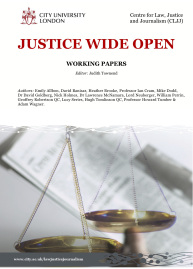
New working papers launched: ‘Justice Wide Open’

In Announcements, Events, Journalism, Law, Publications on June 20, 2025 at 2:27 pm

New publication calls for an increasingly open and digitised approach to open justice

The real “democratic deficit” in the courts is about limited public access not “unelected judges“, Adam Wagner, a barrister at One Crown Office Row, argued on the UK Human Rights Blog at the weekend, challenging a recent political and media narrative.

In his view, the internet age necessitates “a completely new understanding of the old adage ‘Not only must Justice be done; it must also be seen to be done‘”.

Wagner is one of 14 authors who contributed to a new working publication entitled ‘Justice Wide Open’, produced by the Centre for Law, Justice and Journalism (CLJJ), City University London, following an event on February 29 2012. The individual chapters can be accessed electronically.

The new collection of working papers is part of a wider project encouraging ‘Open Justice in the Digital Era‘. The issues are extensive and diverse: the recommendations of the government’s ‘secret justice’ green paper, now the Justice & Security bill, which would see more cases behind closed doors; the decline in local and national court reporting as a result of cuts in journalism; the courts’ barriers to entry due to ill-informed staff; and the difficulties in obtaining free legal information.

Read the rest of this entry »

Upcoming event: Historicising the UK phone hacking scandal - Colin Agur

In Events, Journalism, Law, Social sciences on June 1, 2025 at 12:17 pm

City Media Network and Sociology Department PhD students seminar series invite you to:

Historicising the UK phone hacking scandal: the origins of wiretapping and early cases in the United States and Britain with Colin Agur (Columbia University, Graduate School of Journalism)

  • Tuesday 3 July, 2012, 16:00PM
  • Room D318, Social Sciences Building, City University London, Northampton Square, London, EC1 OHB

The ongoing revelations of widespread phone hacking by NewsCorp raise questions about journalistic ethics and how effectively governments can protect privacy in a world of mass mobile phone usage. To understand the significance of the current scandal, we can look to the origins of wiretapping: the relationship between the telephone and recording technology dates back to their nearly simultaneous releases in the 1870s. Since then, as technologies have improved, wiretapping has became a favored tool in police investigations on both sides of the Atlantic, and the subject for several scandals. This talk explores the roles different parties (bootleggers, bookies, police, journalists) have played in the growth and sophistication of telephone surveillance. It contextualises the current UK scandal, showing how a tactic developed by and for police has been put to use by powerful corporate actors.

Read the rest of this entry »

Introducing the Crime, Justice and Society Research Group

In City University London, Events, Justice, Law on May 28, 2025 at 10:10 am

This group, based at City University London, was established to research and examine issues relating to the interactions between the law, its application and representation (for example in the media) and the agencies dealing with it. The research areas are: Criminal Law, Criminal Justice and Socio-Legal studies.

Therefore, the group aims at including academics from both the Law School and the School of Criminology. We hold a series of seminars at City University with speakers who present research papers in areas such as: the changing nature of news media-police chief relations, the criminal justice system in the socio-legal context and historical perspectives on corporate liability.

Our mission is to contribute to the enhancement of the Criminal Law and Criminal Justice research cluster via seminars, conferences and workshops that focus on innovative perspectives on the contextualization of the law and criminal justice system.

For further information please contact the group convener Dr. Riccardo Montana (Riccardo.Montana.1@city.ac.uk).

More information here.

Upcoming seminars

  • “Phone-hacking, Riots, Looting, Gangs and Police Chiefs: Sir Hugh Orde’s ‘Trial by Media’”, Dr. Chris Greer and Prof. Eugene McLaughlin, Wednesday 30 May, City University London

Past seminars

  • “Moral Panics and Punitiveness: Putting a Criminal Justice System in Context”, Dr. Riccardo Montana, 25 April 2025
  • “Corporations and Individual Businesspersons in Domestic and International Criminal Law”, Dr. Grietje Baars, 28 March 2025
Follow

Get every new post delivered to your Inbox.

Join 534 other followers