By Judith Townend
The public interest is at the heart of the debate around privacy injunctions, but do we know what the UK public thinks?
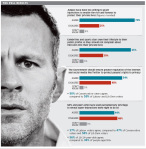
Unfortunately a new ComRes poll for the Independent doesn’t really tell us. While its themes were interesting - asking participants to consider celebrities’ right to privacy - its structure was problematic.
ComRes interviewed 1,001 adults in Great Britain by telephone between 27 and 29 May 2025 and states: “data were weighted to be demographically representative of all GB adults. Data were also weighted by past vote recall”. The full poll can be downloaded at this link [PDF].
The Inforrm media law blog has analysed its methodology in greater detail here and asks what the outcome might have been had the statements been flipped around:
… “Celebrities and sports stars owe their lifestyle to their public profile so they should not complain about intrusion into their private lives“. Unsurprisingly, 65% agreed with this … the formulation of the question clearly suggests the answer. If the statement had been – “Celebrities and sports stars have rights to privacy like everyone else” – then it seems likely a substantial proportion of respondents, perhaps a majority, would have agreed.
The introduction to the issue was alarmingly simplistic too. Each statement was introduced like this: “Thinking about super-injunctions, do you agree or disagree with each of the following statements?”
 The survey does not appear to have explained its definition of a super injunction, or acknowledged the complexities of this phrase. As I have explained elsewhere, there is a distinction between an anonymous privacy injunction and a secret ‘super’ injunction whose very existence cannot be reported. Lord Neuberger’s recent report made the same distinction.
Inforrm concludes:
The Independent survey appears to have been designed to prove a point. However, even against the background of the events of the past few weeks, with heavy hints and plentiful references to super-injunctions it is clear that a substantial proportion of the public has not bought into the media account of these issues.
More research is needed. The question is, therefore, how to formulate a survey that breaks free of the media narrative and presents the issues fairly?

 admin
admin jtownend
 citycljj
 sammc123
 Natalie
 oliverocallaghancity
 Jamie Thunder


[...] an issue I wrote about yesterday over on the Centre for Law, Justice and Journalism Blog following the methodologically [...]
[...] and Meeja Law have been writing about other things: a flawed ComRes poll on super injunctions on the CLJJ blog, publicity issues in the Court of Protection for the Inforrm blog, a privacy law event at [...]
[...] *The survey’s explanation of a “super injunction” left me somewhat dissatisfied. As Meeja Law’s Super Injunction page shows, definitions have varied between publications. A survey conducted by ComRes behalf of the Independent earlier in the year also failed to clarify what it meant by “super injunction”. [...]